20×4.0 Fat Tire Electric Bike: Why Are Wide Tires Better for All-Terrain Riding?

Why Choose a 20×4.0 Fat Tire Electric Bike?
A fat tire electric bike is designed differently from a conventional city e-bike.
Instead of using narrow bicycle tires optimized primarily for smooth pavement, a fat tire e-bike uses significantly wider tires to provide a larger contact area between the bicycle and the riding surface.
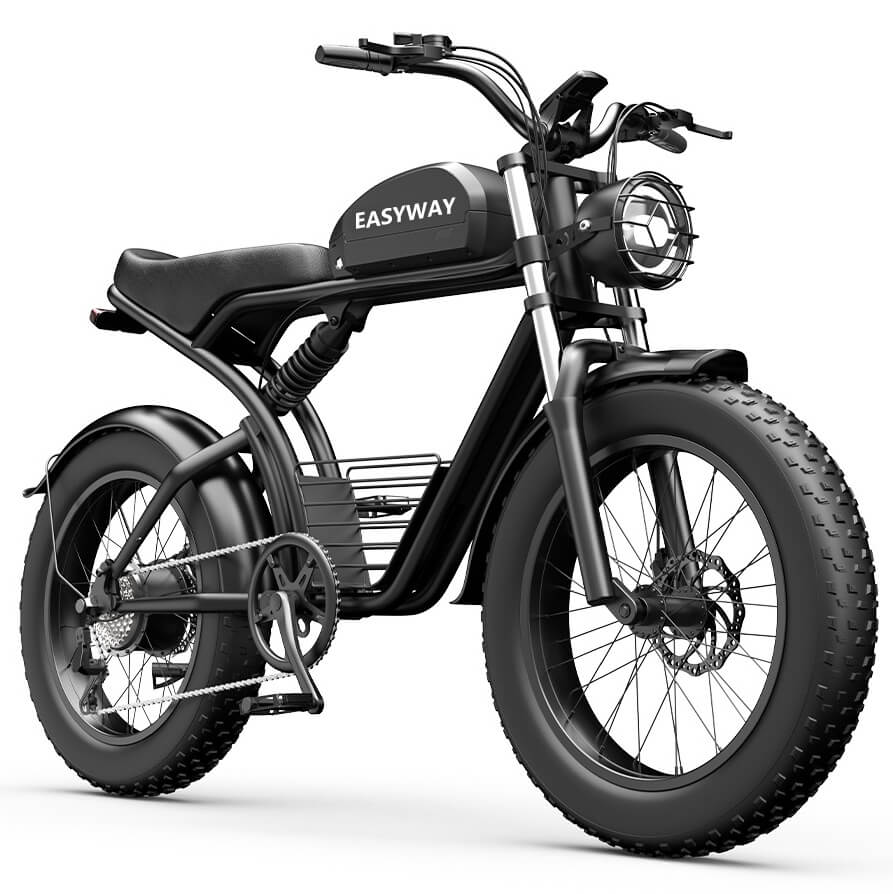
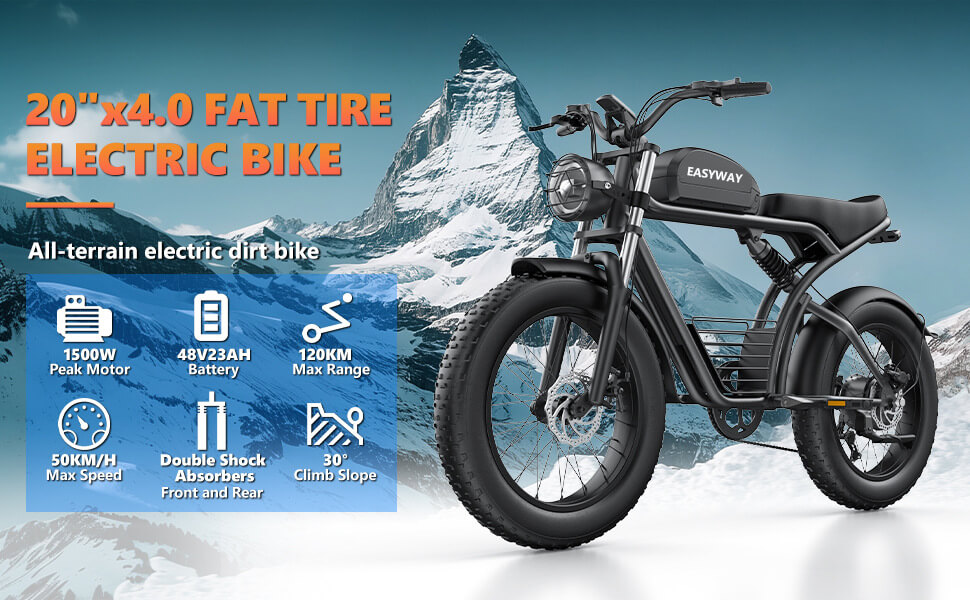
The Easyway F7 Fat Tire E-Bike uses 20×4.0-inch all-terrain fat tires, combined with a full-suspension system consisting of hydraulic front suspension and a rear spring shock.
This configuration is particularly relevant for riders who want to move between:
- Paved roads
- Gravel
- Dirt
- Forest paths
- Uneven roads
- Sand
- Other recreational off-road environments
The key advantage of a fat tire is not simply that it “looks bigger.”
The wider tire can influence traction, stability, comfort and control, especially when the riding surface becomes loose or uneven.
However, fat tires are not magic. Actual performance depends on tire pressure, tread design, surface conditions, rider weight, riding speed and rider skill.
For this reason, the F7 should be considered an all-terrain-oriented electric bike configuration, rather than a bicycle that is guaranteed to perform equally well on every possible surface.
What Does 20×4.0 Mean on a Fat Tire E-Bike?
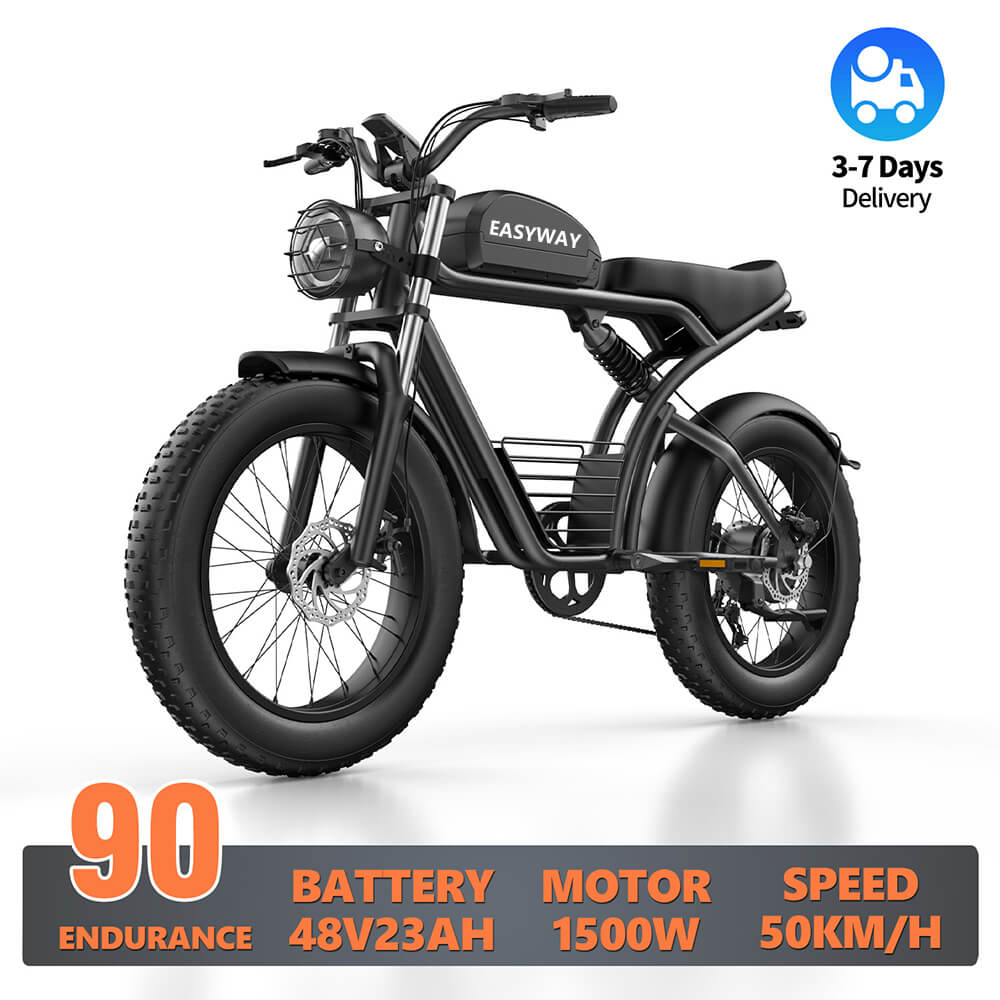
The specification 20×4.0 describes the approximate wheel diameter and tire width.
The 20-inch designation refers to the wheel/tire size category, while 4.0 inches describes the approximate tire width.
A 4-inch-wide tire is considerably wider than many standard bicycle tires.
This wider profile creates a larger footprint between the tire and the ground.
That can be useful when riding over surfaces where a narrow tire may feel less stable, such as:
- Loose gravel
- Dirt
- Sand
- Snow
- Grass
- Uneven trails
The wider footprint can help distribute the rider and bicycle’s weight over a larger area.
However, tire width is only one factor.
Tread pattern, tire pressure, rubber compound, wheel design and terrain all influence how the tire behaves.
Therefore, when comparing fat tire electric bikes, buyers should look beyond the phrase “4-inch fat tire” and evaluate the complete wheel and chassis configuration.
How Do Fat Tires Improve Stability?
One of the most noticeable differences between a fat tire e-bike and a conventional bicycle is stability.
A wider tire can provide a broader contact area with the ground.
This can make the bicycle feel more planted when riding over loose or irregular surfaces.
For example, on a gravel road, small stones can move underneath the tire.
A wider tire can help maintain a more stable contact patch.
On soft surfaces such as sand, tire width can also become important because a wider tire can help distribute load over a larger area.
This is sometimes described as improved flotation.
However, flotation depends heavily on tire pressure and the specific surface.
A tire that is appropriate for firm gravel may behave differently on very soft sand.
For F7 riders, the correct tire pressure should therefore be selected according to the manufacturer’s recommendations and riding conditions.
Are 20×4.0 Fat Tires Good for Gravel Roads?
Yes, a 20×4.0 fat tire configuration can be well suited to many gravel-road applications.
Gravel presents a different challenge from smooth pavement because the surface contains loose stones and irregularities.
A narrow tire can feel more sensitive to changes in surface texture.
A wider fat tire can provide a broader contact area and can help create a more stable riding platform.
The F7 combines its 20×4.0 tires with:
- Full suspension
- Mechanical disc brakes
- 7-speed transmission
- Adjustable seat
This creates a configuration designed for more than simply riding around smooth city streets.
However, gravel surfaces vary significantly.
A compacted gravel path is very different from a steep trail covered in loose rocks.
Riders should always adjust speed and riding technique according to actual trail conditions.
NHTSA recommends checking bicycle tires for appropriate air pressure, cuts and worn tread as part of a pre-ride safety check.
NHTSA – Bicycle Safety: Pre-Ride Safety Check
This is particularly relevant to fat tire e-bikes because tire pressure directly influences handling, rolling resistance and contact with the riding surface.
Are Fat Tire E-Bikes Suitable for Sand?
Sand is one of the environments where tire width becomes particularly important.
A narrow bicycle tire can sink more easily into loose sand because the load is concentrated over a relatively small contact area.
A wider fat tire can distribute that load over a larger footprint.
This can improve flotation and help reduce the tendency of the tire to sink.
The F7’s 20×4.0-inch tires therefore provide a configuration that can be useful for recreational riding on suitable sandy surfaces.
However, riders should not assume that every 4-inch tire will perform the same way on every type of sand.
Performance depends on:
- Sand depth
- Moisture
- Tire pressure
- Tread pattern
- Rider weight
- Motor assistance
- Riding speed
Very soft, deep sand can remain difficult even for a fat tire e-bike.
What About Dirt and Forest Trails?
Dirt trails can contain a mixture of surfaces.
A single trail might include:
- Hard-packed soil
- Loose dirt
- Small rocks
- Tree roots
- Mud
- Puddles
- Uneven sections
This is where the combination of fat tires and suspension becomes particularly useful.
The tires provide the connection with the ground, while the suspension helps manage impacts from uneven surfaces.
The F7 uses a hydraulic front suspension and rear spring shock, creating a full-suspension configuration.
This means the front and rear of the bicycle are equipped to manage impacts rather than relying only on tire deformation.
Why Does Full Suspension Matter on an All-Terrain E-Bike?
Fat tires and suspension solve different problems.
Understanding the difference is important.
Fat Tires
Primarily influence:
- Traction
- Stability
- Contact area
- Flotation
- Rolling behavior
Suspension
Primarily influences:
- Impact absorption
- Rider comfort
- Wheel control
- Handling over uneven terrain
The F7 uses:
Hydraulic front suspension + rear spring shock
When riding over a rough trail, the tire encounters the obstacle first.
The suspension then helps manage the movement generated by that impact.
This can help the rider maintain better control and reduce the harshness transmitted through the bicycle.
It is therefore the combination of tire and suspension, rather than either component alone, that makes the F7 suitable for a wider variety of terrain.
F7 20×4.0 Fat Tire Electric Bike
How Does Tire Pressure Affect All-Terrain Performance?
Tire pressure is one of the most important variables for fat tire riding.
Higher pressure can reduce tire deformation and may work well on firmer surfaces.
Lower pressure can increase the tire’s ability to conform to certain uneven surfaces and can sometimes improve traction on loose terrain.
But lower is not always better.
Excessively low pressure can increase the risk of:
- Rim damage
- Poor handling
- Excessive tire deformation
- Increased rolling resistance
- Tire damage
The correct pressure should therefore be based on the tire manufacturer’s specifications and the riding conditions.
For B2B buyers, this is also an important consideration when preparing product manuals and customer education materials.
Does a Fat Tire E-Bike Ride Well on Pavement?
Fat tires are not only for off-road riding.
The F7 can also be used on paved roads and urban surfaces, depending on local regulations and the intended application.
On pavement, the wider tires can provide a stable and comfortable riding feel.
However, there are trade-offs.
Compared with narrow road-oriented tires, fat tires can have:
- Higher rolling resistance
- Greater weight
- More surface contact
- Different steering characteristics
Therefore, the ideal tire configuration depends on the user’s priorities.
A customer who only rides smooth roads may prefer a narrower tire.
A customer who frequently transitions between pavement and gravel may prefer the versatility of a fat tire.
This is where the F7’s all-terrain configuration becomes relevant.
How Does the 7-Speed Gear System Help on Different Terrain?
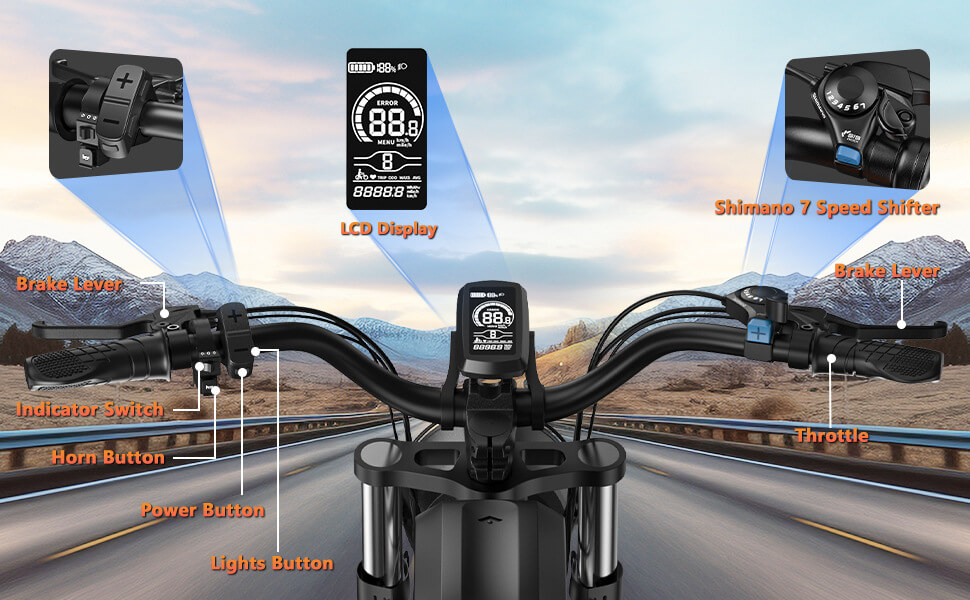
The F7 also uses a 7-speed gear system compatible with Shimano components.
Gearing provides another way to adapt the bike to changing terrain.
Lower gears can make pedaling easier when climbing.
Higher gears can provide a more suitable cadence when riding faster on flatter surfaces.
This means the rider does not have to rely entirely on the motor.
The combination of:
Electric assistance + multiple gears
can provide greater flexibility across different riding environments.
For an all-terrain e-bike, this can be especially useful when a route changes from flat pavement to an incline or uneven trail.
Why Do Brakes Matter on Fat Tire E-Bikes?
A good all-terrain e-bike needs more than traction.
It also needs effective control when slowing down.
The F7 uses mechanical disc brakes.
Braking becomes particularly important when riding:
- Downhill
- On gravel
- On wet roads
- With a heavier rider
- At higher speeds
- On uneven surfaces
A tire may provide traction, but the rider still needs a braking system that is properly adjusted and maintained.
NHTSA recommends checking bicycle brakes before riding and ensuring that brake pads, cables and related components are in good condition.
NHTSA – Bicycle Safety Tips for Adults and Kids
This provides an authoritative reference for basic bicycle safety practices that are also relevant to electric bicycles.
How Does the F7 Combine Tires, Suspension and Brakes?
The F7’s all-terrain configuration can be understood as several systems working together.
20×4.0 Fat Tires
Provide:
- Wide contact area
- Traction
- Stability
- All-terrain capability
Full Suspension
Provides:
- Impact absorption
- Better wheel control
- Improved comfort
Mechanical Disc Brakes
Provide:
- Controlled stopping
- Reliable braking
- Better suitability for varied terrain
7-Speed Transmission
Provides:
- Gear selection
- Climbing flexibility
- Better cadence management
The result is a complete riding system rather than a bicycle relying on one individual component.
What Makes the F7 an All-Terrain Electric Bike?
The F7 is built around several features that support mixed-terrain riding:
20×4.0-inch all-terrain fat tires
→ Wide tire footprint and stability
Full suspension
→ Hydraulic front + rear spring shock
Mechanical disc brakes
→ Controlled stopping
7-speed transmission
→ Adaptable gearing
48V electrical system
→ Supports the F7’s electric drive system
These specifications make the F7 suitable for buyers looking for an electric bike that can transition between paved roads and recreational off-road environments.
For an electric bike used across different environments, safety should be considered as a complete system rather than focusing on only one component.
UL Solutions explains that UL 2849 evaluates the electrical drive train, battery system and charger system combinations of e-bikes.
UL Solutions – E-Bikes Certification and UL 2849
For international buyers, the exact certification status and applicable requirements should always be verified for the final product configuration and target market.
All-Terrain Does Not Mean Every Terrain
The phrase “all-terrain” should be used carefully.
An all-terrain electric bike generally means that the configuration is designed to handle a broader variety of surfaces than a road-focused bicycle.
It does not mean that the bike is suitable for:
- Extreme downhill racing
- Technical mountain-bike competition
- Deep mud without limitations
- Very deep sand
- Flooded terrain
- Dangerous trails beyond the bike’s design limits
Riders should always match the bike to the environment.
Speed should also be reduced when visibility, traction or surface conditions deteriorate.
Fat Tire E-Bike OEM & ODM Solutions
Who Is a 20×4.0 Fat Tire E-Bike Suitable For?
The F7’s configuration can be relevant to several user groups.
Outdoor Adventure Riders
For riders who want to explore gravel roads, dirt paths and recreational trails.
Mixed-Terrain Commuters
For users whose routes combine pavement, rough roads and occasional unpaved sections.
Recreational Riders
For customers looking for a more stable and versatile riding platform.
Outdoor Mobility and Lifestyle Brands
For brands looking to add a high-power fat tire e-bike to their product portfolio.
The right application ultimately depends on local regulations, terrain and the intended customer profile.
Frequently Asked Questions
Are 20×4.0 fat tires good for off-road riding?
Yes. Their wide footprint can provide useful traction and stability on many loose or uneven surfaces. Actual performance depends on tire pressure, tread, terrain and rider skill.
Are 4-inch fat tires good for sand?
They can be useful on suitable sandy surfaces because the wider footprint can improve flotation. Very soft or deep sand can still be challenging.
Can a fat tire e-bike ride on gravel?
Yes. 20×4.0 fat tires can be well suited to many gravel surfaces, especially when combined with appropriate tire pressure and suspension.
Does the F7 have full suspension?
Yes. The F7 uses a hydraulic front suspension and rear spring shock.
Are fat tires comfortable on pavement?
They can provide a stable and cushioned riding feel, although they may have greater rolling resistance than narrower road-oriented tires.
What size tires does the F7 use?
The F7 uses 20×4.0-inch all-terrain fat tires.
Does the F7 have disc brakes?
Yes. The F7 uses mechanical disc brakes.
Conclusion: Why Choose a 20×4.0 Fat Tire Electric Bike?
A fat tire electric bike is more than a bicycle with wider tires.
The wider tire can improve stability and traction, while suspension helps manage impacts from uneven terrain. Gearing provides flexibility, and disc brakes provide controlled stopping.
The Easyway F7 combines these elements with 20×4.0-inch all-terrain fat tires, full suspension, mechanical disc brakes and a 7-speed transmission.
This makes it a practical configuration for riders and B2B buyers looking for an electric bike that can move beyond smooth pavement and handle a wider variety of recreational and mixed-terrain environments.
The most important takeaway is simple:
The value of a fat tire e-bike comes from how the tires, suspension, drivetrain and braking system work together—not from tire width alone.
Request F7 Wholesale & OEM Information