
Full Suspension Electric Bike: How the F7 Improves Comfort and Control on Rough Roads

Why Does Suspension Matter on an Electric Bike?
An electric bike can have a powerful motor and a large battery, but those specifications alone do not determine how comfortable or controllable the bike feels on rough terrain.
When the road becomes uneven, the bicycle needs to deal with:
- Potholes
- Gravel
- Small rocks
- Roots
- Uneven pavement
- Dirt roads
- Repeated bumps
This is where suspension becomes important.
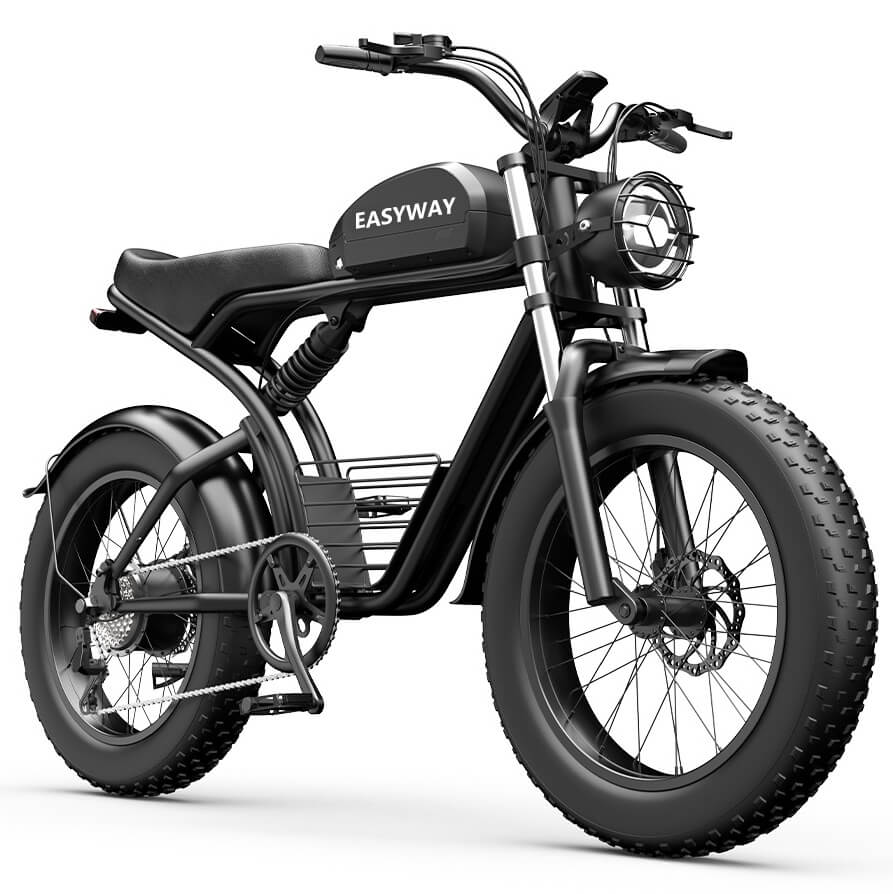
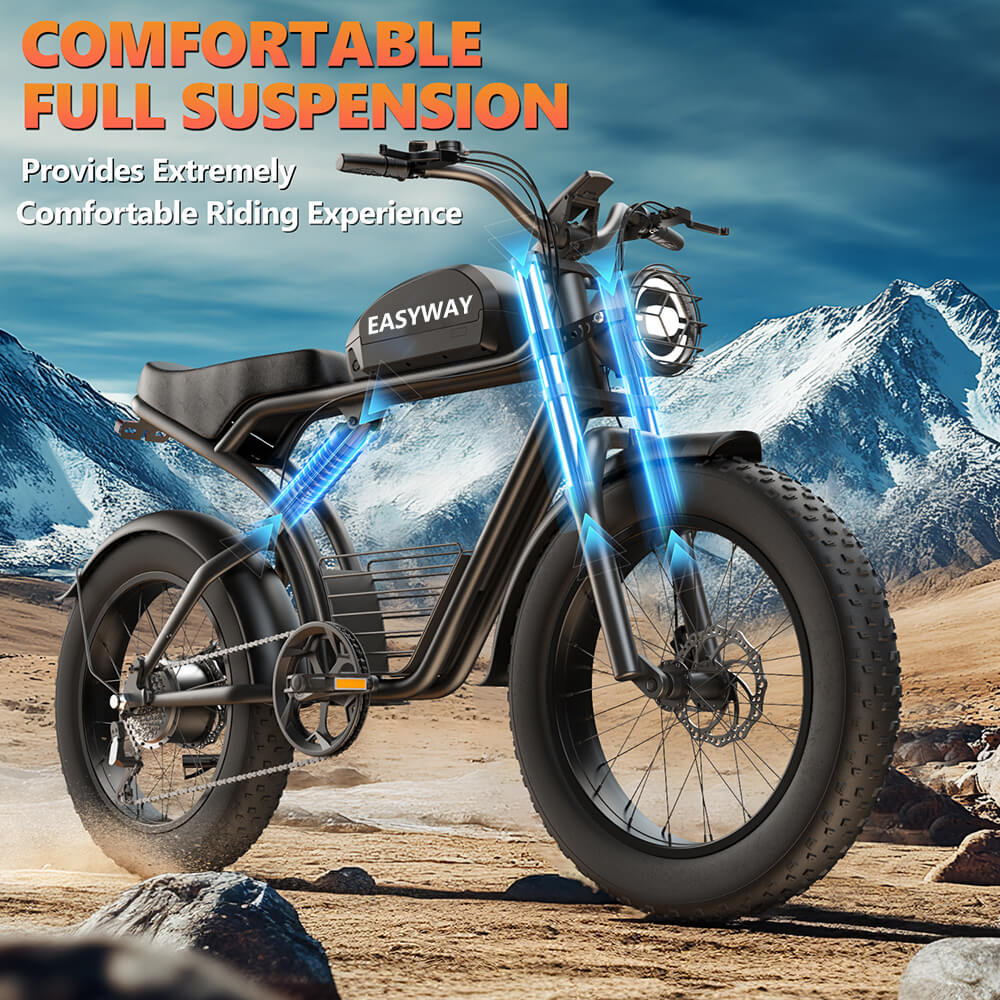
The Easyway F7 Fat Tire E-Bike uses a full suspension configuration, combining a hydraulic front suspension with a rear spring shock.
Instead of allowing every impact to travel directly through the wheels and frame to the rider, the suspension system helps absorb and manage movement caused by uneven terrain.
This can contribute to:
Better comfort + better wheel control + a more stable riding experience
The F7 also combines suspension with 20×4.0 fat tires, mechanical disc brakes, a 7-speed transmission and an adjustable seat.
The result is a configuration designed not only to provide electric assistance, but also to make longer and more varied rides easier to manage.
What Is a Full Suspension Electric Bike?
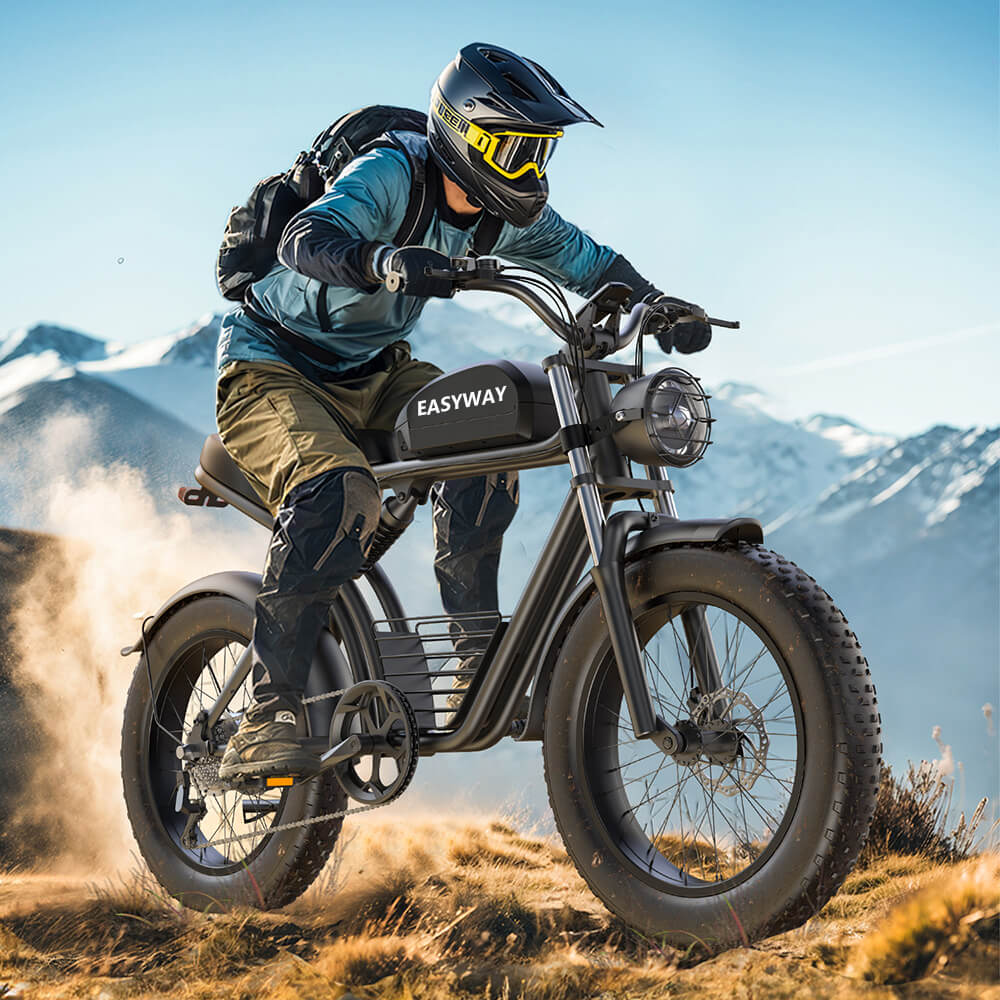
A full suspension electric bike has suspension at both the front and rear of the bicycle.
This is different from a front-suspension-only design.
The F7 uses:
Front: Hydraulic suspension
Rear: Spring shock
The front suspension helps manage impacts encountered by the front wheel.
The rear shock helps manage impacts transmitted through the rear wheel and frame.
When these systems work together, the bicycle can respond more effectively to uneven terrain.
However, suspension does not mean that the bike can simply ignore obstacles.
Riders still need to:
- Reduce speed on rough surfaces
- Avoid dangerous obstacles
- Maintain proper tire pressure
- Keep the suspension properly maintained
- Adjust riding technique according to terrain
Suspension is therefore a control and comfort system, not a replacement for safe riding.
How Does Front Suspension Help?
The front wheel is often the first part of the bicycle to encounter an obstacle.
Imagine riding over a small pothole.
Without suspension, the front wheel moves sharply upward as it encounters the edge.
With hydraulic suspension, the fork can compress and control this movement.
This can help reduce the impact transmitted toward:
- Handlebars
- Rider’s arms
- Upper body
- Front frame section
For riders who spend extended periods on mixed surfaces, this can make a noticeable difference.
The F7’s hydraulic front suspension is particularly useful when transitioning between pavement, gravel and uneven roads.
What Does Rear Suspension Add?
Rear suspension addresses a different part of the riding experience.
When the rear wheel travels over a bump, the impact can be transferred through the rear frame and saddle.
The F7 uses a rear spring shock to help absorb rear-wheel movement.
This can improve comfort for riders when traveling across rougher surfaces.
It can also help the rear wheel maintain better contact with the ground as the bike moves across uneven terrain.
This is important because traction and comfort are closely connected.
If the rear wheel repeatedly loses contact with the ground, the rider may experience reduced stability.
A properly designed suspension system helps the bicycle respond more progressively to surface changes.
Suspension and Fat Tires: Why Work Them Together?
Suspension and fat tires have different jobs.
The 20×4.0 fat tires provide a wide contact area and help the bicycle maintain stability and traction.
The suspension system manages larger impacts and movement from uneven terrain.
Think of the system this way:
Fat Tire → Ground Contact
Suspension → Impact Management
Frame → Structural Support
Brakes → Stopping Control
Together, these components create a more complete riding platform.
This is why evaluating an electric bike by looking at only one component can be misleading.
A powerful motor may provide acceleration, but tires, suspension and brakes determine how effectively the rider can control that performance.
The U.S. Consumer Product Safety Commission provides bicycle safety guidance covering areas such as braking, tire condition and safe riding practices.
U.S. CPSC – Bicycle Safety
This is a useful authoritative reference because suspension and tire performance should always be considered together with basic bicycle safety and maintenance.
Why Is an Adjustable Seat Important?
The F7 also features an adjustable seat.
This may appear to be a small detail compared with the motor or battery, but seat adjustment can have a significant influence on riding comfort.
Riders have different:
- Heights
- Leg lengths
- Riding postures
- Preferences
- Riding styles
A fixed saddle position cannot provide the same flexibility for every rider.
An adjustable seat allows the rider to find a more appropriate position.
Correct saddle height can influence:
- Pedaling efficiency
- Leg extension
- Riding posture
- Comfort
- Control
This becomes increasingly important on longer rides.
A rider who spends one or two hours on the bike may notice ergonomic differences much more than someone taking a short five-minute trip.
F7 Full Suspension Fat Tire Electric Bike
How Does a 7-Speed Gear System Improve Riding?
Electric assistance does not eliminate the need for gears.
The F7 uses a 7-speed gear system compatible with Shimano components.
Gears allow the rider to change the mechanical advantage between pedaling effort and wheel rotation.
On an uphill section, a lower gear can make pedaling easier.
On flatter terrain, a higher gear can allow the rider to maintain a more suitable cadence.
This becomes especially useful when the route changes frequently.
For example:
Flat road → higher gear
Moderate incline → middle gear
Steep climb → lower gear
The motor provides electric assistance while the gear system allows the rider to manage pedal effort.
This combination can create a more flexible riding experience than relying entirely on throttle input.
Why Is a 7-Speed System Useful on Long Rides?
Different terrain requires different pedaling conditions.
Imagine a 30-kilometer recreational route.
The first section may be flat pavement.
The second section could be a gradual climb.
The third section might consist of gravel.
The final section may return to pavement.
Using the same gear for the entire route would not necessarily be the most comfortable approach.
A 7-speed system allows riders to adapt.
This can reduce unnecessary pedaling effort and make it easier to maintain a comfortable cadence.
For a fat tire electric bike intended for mixed terrain, this flexibility can be more useful than a single-speed configuration.
Why Do Mechanical Disc Brakes Matter?
Acceleration is only one part of an electric bike’s performance.
The rider also needs to slow down and stop.
The F7 uses mechanical disc brakes.
Disc brakes are positioned around the wheel hub area rather than relying on a traditional rim-braking surface.
This design can provide consistent braking control when properly adjusted and maintained.
Braking becomes particularly important when riding:
- Downhill
- On gravel
- On wet pavement
- With additional cargo
- At higher speeds
- On uneven terrain
A heavier and more powerful electric bike places greater importance on predictable braking.
The F7’s braking system therefore complements its motor, suspension and fat tires.
How Should Riders Maintain Mechanical Disc Brakes?
Mechanical disc brakes are relatively straightforward to inspect and maintain.
Important maintenance areas include:
Brake Pads
Brake pads gradually wear through use.
They should be inspected and replaced when necessary.
Brake Cables
Mechanical brakes use cables to transfer lever input to the brake mechanism.
Cable condition and adjustment influence braking response.
Brake Rotors
Rotors should remain clean and properly aligned.
Brake Lever
The lever should provide consistent resistance and return normally after operation.
Regular inspection is especially important for e-bikes used frequently on rough terrain.
How Do Suspension and Brakes Work Together?
Suspension and brakes may appear to be unrelated components, but they influence overall control.
Consider a downhill gravel road.
The rider needs:
Tire traction
to maintain contact with the surface.
Suspension
to manage bumps.
Brakes
to control speed.
Gears
to manage pedaling effort.
Frame
to provide structural support.
The quality of the riding experience therefore comes from how these components interact.
A bike with strong acceleration but poor control would not be an ideal all-terrain solution.
Likewise, a comfortable bicycle without appropriate braking performance would not provide the same level of confidence.
The F7 is designed around this complete-system approach.
Why Does Rider Position Matter?
The relationship between rider and bicycle is another important factor.
The F7’s adjustable seat allows riders to modify the saddle position according to their body dimensions and riding preference.
An appropriate riding position can help the rider maintain:
- Balanced weight distribution
- Comfortable leg extension
- Stable steering
- Better pedaling position
This becomes particularly important when riding over uneven terrain.
Riders may naturally shift their body position when climbing, descending or moving across rough surfaces.
A properly adjusted saddle provides a better starting position for these movements.
Comfort Is More Than Softness
When people talk about a “comfortable electric bike,” they often think only about soft suspension.
But comfort is actually a combination of several factors.
For the F7, these include:
20×4.0 Fat Tires
→ Help absorb smaller surface irregularities.
Front Hydraulic Suspension
→ Helps manage impacts at the front.
Rear Spring Shock
→ Helps manage rear-wheel impacts.
Adjustable Seat
→ Allows ergonomic adjustment.
7-Speed Transmission
→ Allows riders to select an appropriate gear.
These features address different sources of rider fatigue.
That makes the F7 more than simply a high-power electric bicycle.
How Does Rider Weight Affect Suspension Setup?
Suspension performance depends partly on rider weight.
A lighter rider and a heavier rider do not place the same load on the suspension system.
For this reason, suspension should be adjusted according to the manufacturer’s recommendations and intended rider/load conditions.
The F7 supports a stated maximum load of 150 kg, but maximum load should not be confused with ideal suspension setup.
A bike can technically support a certain load while still requiring appropriate adjustment for optimal comfort and control.
For B2B customers, this is an important point when developing product manuals, dealer training and customer support materials.
PeopleForBikes provides industry and consumer resources related to bicycle safety, maintenance and responsible riding.
PeopleForBikes – Bike Safety & Education
This type of guidance is useful for distributors because correct rider education and basic maintenance are important parts of the ownership experience.
Is Full Suspension Better for City Riding?
Not necessarily for every rider.
Full suspension adds components, weight and complexity compared with a rigid bicycle.
If a rider only travels on smooth pavement, a rigid or front-suspension configuration may already provide sufficient comfort.
The advantages become more noticeable when the riding environment includes:
- Broken pavement
- Potholes
- Gravel
- Dirt roads
- Uneven trails
- Longer recreational rides
Therefore, the F7’s full-suspension design is best understood as a feature for versatility and rough-surface comfort, rather than a universal requirement for every electric bike.
Why Is the F7 Suitable for Mixed-Terrain Riding?
The F7 combines several components that complement each other.
Full Suspension
Hydraulic front suspension + rear spring shock.
Fat Tires
20×4.0 all-terrain tires.
Gearing
7-speed transmission.
Braking
Mechanical disc brakes.
Ergonomics
Adjustable seat.
Together, these features create a bicycle that can transition between different environments without being designed exclusively for one type of road.
This is particularly relevant for outdoor lifestyle brands and distributors looking for a versatile electric bike product.
Electric Bike OEM & ODM Manufacturing
What Should Buyers Look for in a Comfortable Electric Bike?
For B2B buyers, “comfort” should not be treated as a vague marketing term.
A more useful evaluation includes several measurable or observable areas.
Suspension
Is the bike front suspension or full suspension?
Tires
What is the tire width and intended terrain?
Seat
Can the saddle height be adjusted?
Gearing
Does the bike provide enough gear choices for the target terrain?
Brakes
What braking system is installed?
Frame
What material and load capacity are specified?
The F7 uses a carbon steel frame and has a stated maximum load of 150 kg.
This configuration provides a durable platform for a relatively heavy-duty fat tire electric bike.
What About Water Resistance?
The F7 has a stated IPX5 waterproof rating.
An IP rating provides a standardized way of describing protection against certain environmental conditions.
However, an IP rating does not mean that an electric bicycle can be submerged or safely ridden through any depth of water.
Riders should still avoid:
- Deep flooding
- Submersion
- High-pressure water directly applied to electrical components
- Charging the battery while wet
The bicycle should also be dried appropriately after wet-weather riding.
The IP rating system is defined by the IEC 60529 standard, which classifies the degrees of protection provided by enclosures against ingress of solids and water.
IEC 60529 – Degrees of protection provided by enclosures (IP Code)
This provides an authoritative technical reference when discussing what an IP rating does—and does not—mean.
For the F7, IPX5 should not be interpreted as waterproof or submersible protection.
F7 Configuration at a Glance
The F7’s comfort and control-oriented configuration includes:
Full Suspension
Hydraulic front + rear spring shock
Tires
20×4.0 all-terrain fat tires
Transmission
7-speed gear system
Brakes
Mechanical disc brakes
Seat
Adjustable seat
Frame
Carbon steel
Maximum Load
150 kg
Waterproof Rating
IPX5
These features work together to create an electric bike intended for riders who want more than basic urban transportation.
Frequently Asked Questions
Is a full suspension e-bike more comfortable?
Full suspension can improve comfort and control on uneven terrain by helping manage impacts at both the front and rear of the bicycle. It is less necessary for riders who only use smooth pavement.
Does the F7 have front and rear suspension?
Yes. The F7 uses a hydraulic front suspension and rear spring shock.
What size tires does the F7 use?
The F7 uses 20×4.0-inch all-terrain fat tires.
Does the F7 have gears?
Yes. It uses a 7-speed gear system compatible with Shimano components.
What type of brakes does the F7 use?
The F7 uses mechanical disc brakes.
Can the seat height be adjusted?
Yes. The F7 features an adjustable seat.
Is the F7 waterproof?
The F7 has a stated IPX5 rating. This indicates a level of water protection, but it does not mean the bicycle is waterproof or suitable for submersion.
What is the maximum load?
The stated maximum load is 150 kg.
Conclusion: Why Choose a Full Suspension Electric Bike?
A comfortable electric bike needs more than a powerful motor.
When riders travel across rough roads or mixed terrain, the bicycle must manage impacts, maintain traction, provide predictable braking and allow the rider to maintain a comfortable position.
The Easyway F7 addresses these requirements through a combination of:
- Hydraulic front suspension
- Rear spring shock
- 20×4.0 fat tires
- Mechanical disc brakes
- 7-speed transmission
- Adjustable seat
- Carbon steel frame
- IPX5 water-resistance rating
Each component has a different role.
The tires connect the bike to the ground.
The suspension manages impacts.
The gears help manage pedaling effort.
The brakes control speed.
The adjustable seat supports rider ergonomics.
Together, these features make the F7 a versatile full suspension fat tire electric bike for riders and B2B buyers looking for greater comfort and control across mixed riding environments.
The best all-terrain e-bike is not simply the one with the most power. It is the one that gives riders the right combination of power, traction, suspension, braking and ergonomic control.
Request F7 Wholesale & OEM Information