How to Choose a High-Power Fat Tire E-Bike for Wholesale and OEM Projects

What Should B2B Buyers Look for in a Fat Tire Electric Bike?
For consumers, buying an electric bike often starts with a simple question:
“Is this bike right for me?”
For distributors, wholesalers and brands, the purchasing decision is much more complicated.
A B2B buyer needs to consider:
- Motor configuration
- Battery capacity
- Range
- Tire size
- Suspension
- Braking system
- Frame capacity
- Certifications
- Packaging
- MOQ
- Production capability
- OEM customization
- Target-market requirements
- After-sales support
The Easyway F7 Fat Tire E-Bike is designed around this type of multi-factor evaluation.
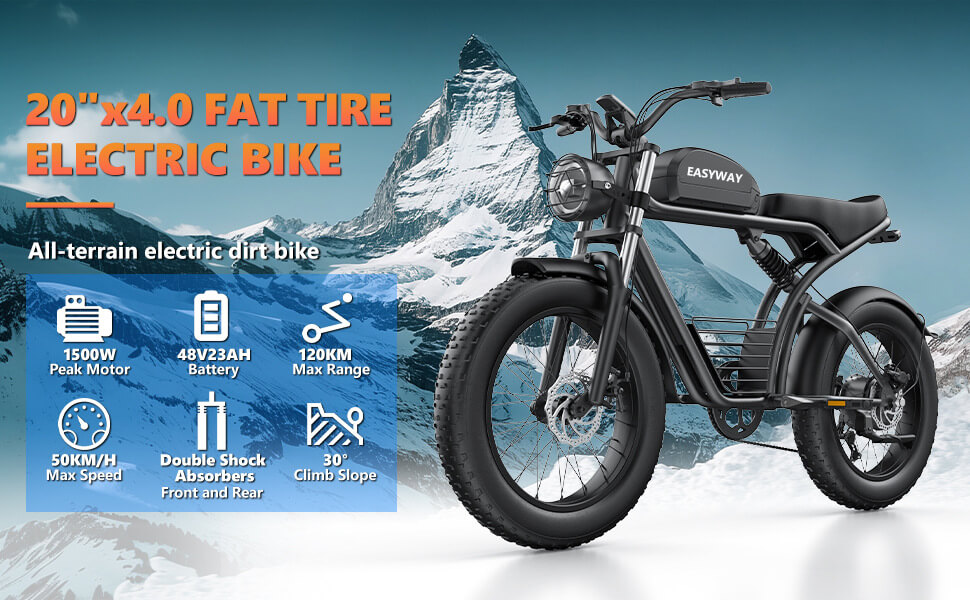
It combines a 48V 1500W brushless hub motor, 48V 23Ah lithium battery, 20×4.0 fat tires, full suspension, mechanical disc brakes and a 7-speed transmission.
For B2B buyers, the value of the F7 is therefore not just one specification.
It is the combination of a complete product configuration with the possibility of bulk purchasing and customization.
Why Is Product Configuration Important for Wholesale Buyers?
A distributor is not simply buying individual components.
They are buying a complete product proposition.
For example, a 1500W motor may sound attractive, but if the battery is too small, the bike may not deliver the desired riding experience.
Similarly, a large battery does not automatically create a good all-terrain e-bike if the tires, suspension and braking system are poorly matched.
The F7 uses a system-oriented configuration:
48V 1500W Motor
Provides high-power propulsion.
48V 23Ah Battery
Provides approximately 1,104Wh of nominal battery energy.
20×4.0 Fat Tires
Support stability and traction across mixed surfaces.
Full Suspension
Hydraulic front suspension + rear spring shock.
Mechanical Disc Brakes
Provide controlled braking.
7-Speed Transmission
Provides multiple gear choices for different riding conditions.
For a B2B buyer, this type of complete configuration can be easier to position as a finished product rather than as a collection of disconnected specifications.
How Should Buyers Evaluate a 1500W Electric Bike?
Motor power is one of the first specifications many buyers notice.
The F7 uses a:
48V 1500W high-speed brushless hub motor
A high-power motor can be useful for applications where riders need stronger acceleration or assistance on inclines.
However, B2B buyers should not evaluate motor wattage in isolation.
A more complete evaluation should include:
- Motor voltage
- Rated power
- Controller configuration
- Battery capacity
- Gear system
- Rider/load capacity
- Intended terrain
- Local regulations
The F7 uses a 48V 25A intelligent controller, which is designed as part of the overall electrical system.
This system-level approach is more useful than simply advertising the highest motor wattage possible.
Why Does Battery Capacity Matter for B2B Buyers?
The F7 uses a:
48V 23Ah 18650 lithium battery pack
Its nominal energy can be estimated as:
48V × 23Ah = 1,104Wh
The stated riding range is 70–120 km, depending on conditions.
For a distributor, however, it is important to understand that advertised range should be treated as a range estimate rather than a guaranteed distance.
Real-world performance can change according to:
- Rider weight
- Riding speed
- Terrain
- Tire pressure
- Temperature
- Wind
- PAS level
- Throttle use
- Stop-and-go riding
This is why professional product listings should communicate battery capacity and estimated range together with appropriate context.
When sourcing e-bikes for international markets, electrical-system safety is an important part of supplier evaluation.
UL Solutions explains that UL 2849 evaluates the electrical drive train, battery system and charger system combination of e-bikes and addresses electrical and fire safety considerations.
UL Solutions – E-Bikes Certification: Evaluating and Testing to UL 2849
What Makes 20×4.0 Fat Tires Attractive for Wholesale?
Fat tire electric bikes have become an important category for outdoor and lifestyle-oriented e-bike brands.
The F7 uses:
20×4.0 all-terrain fat tires
The wider tire configuration gives the product a distinctive visual identity while also supporting stability across a variety of surfaces.
This can make the product easier to position for:
- Outdoor recreation
- Adventure riding
- Mixed-terrain riding
- Lifestyle e-bike markets
- Gravel-road riding
- Beach and recreational applications
For distributors, product positioning matters.
A conventional city e-bike may compete primarily on commuting functionality.
A fat tire e-bike can instead be positioned around:
Adventure + Lifestyle + Power + Versatility
That gives brands another way to differentiate their product portfolio.
F7 48V 1500W Fat Tire Electric Bike
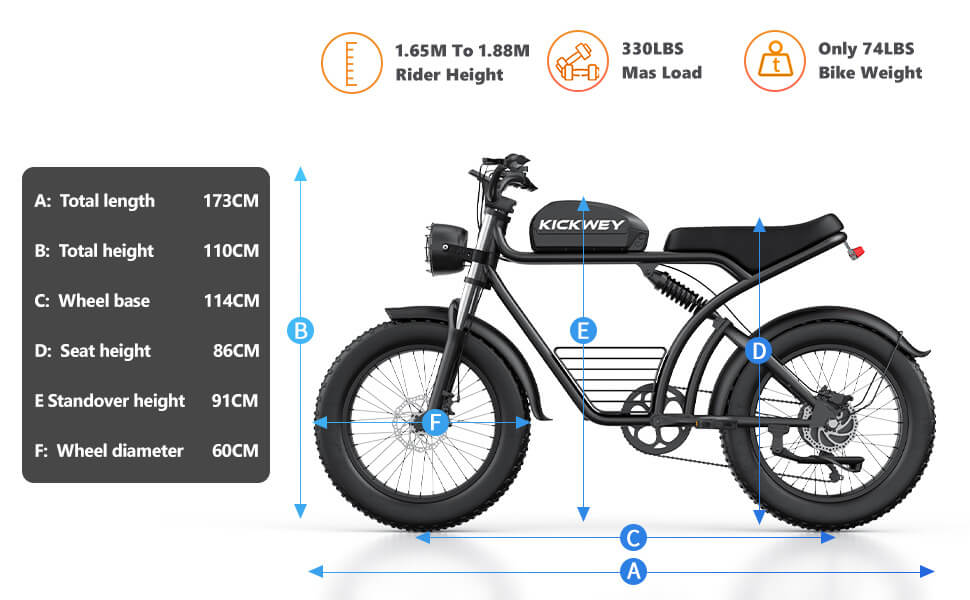
Why Is a 150 kg Load Capacity Useful?
The F7 has a stated maximum load of:
150 kg
For B2B buyers, load capacity is an important specification because different target markets may include riders with different body sizes and usage requirements.
A higher load capacity can also provide more flexibility when positioning the product.
However, maximum load should always be communicated correctly.
It refers to the specified maximum supported load and should not be interpreted as a recommendation to operate continuously at maximum capacity under all conditions.
Rider weight, cargo, terrain and riding speed can all influence actual riding performance.
Why Do Certifications Matter When Sourcing E-Bikes?
Certifications and compliance documentation can become increasingly important as a brand expands into different markets.
A B2B buyer may need to consider:
- Electrical safety
- Battery requirements
- Charger requirements
- EMC requirements
- Product labeling
- Local road-use regulations
- Import requirements
- Transportation requirements
The F7 specification lists support for:
- CE
- UL 2849
- EN15194
However, the exact certification status should always be confirmed for the specific production configuration and target market.
This is important because an e-bike may have different regulatory requirements depending on how it is configured and where it will be sold.
Why Should Buyers Verify Certifications Before Ordering?
Certification should not be treated simply as a marketing badge.
A professional buyer should request documentation and verify:
What product model does the certificate cover?
Which electrical configuration was tested?
Which battery and charger were included?
Who is the certificate holder?
What market or standard does the document apply to?
Does the production configuration match the tested configuration?
These questions can reduce compliance risks when importing products.
For OEM projects, this becomes even more important because changing components may affect the final compliance status.
Why Is OEM Customization Important for E-Bike Brands?
Not every brand wants to sell an identical factory configuration.
An established brand may want to customize:
- Frame color
- Brand logo
- Saddle
- Grips
- Tires
- Display
- Packaging
- Decals
- Accessories
- Battery configuration
- Component selection
This is where OEM/ODM manufacturing becomes valuable.
Instead of starting product development from zero, a brand can begin with an existing platform such as the F7 and then discuss the modifications needed for its market.
This can potentially shorten development time compared with creating an entirely new bicycle platform.
Electric Bike OEM & ODM Manufacturing
What Can Be Customized on an F7 OEM Project?
The exact customization scope depends on the project.
However, an OEM discussion may include:
Brand Identity
Logo, decals, colors and product naming.
Appearance
Frame color, component colors and finishing.
Packaging
Carton design, labels and product documentation.
Components
Depending on technical feasibility, brands may discuss alternative components for specific markets.
Battery
Different battery requirements may be discussed according to product positioning and market regulations.
Accessories
Brands can also evaluate accessories according to their customer segment.
For example, an outdoor lifestyle brand may prioritize adventure-oriented accessories, while an urban brand may prioritize practical commuting accessories.
The goal of OEM is not simply to change the logo.
It is to create a product configuration that fits the brand’s target customer.
Why Is MOQ Important for E-Bike Wholesale?
The F7 has a stated:
MOQ: 50 units
For a distributor, MOQ affects inventory planning and initial investment.
A smaller MOQ can make it easier for a new brand to test a market.
A larger MOQ may be appropriate for established distributors with proven demand.
Therefore, buyers should consider MOQ together with:
- Target sales volume
- Warehouse capacity
- Market size
- Product launch schedule
- Cash flow
- Reorder frequency
For the F7, a 50-unit MOQ provides a reference point for initial B2B discussions.
The exact order quantity should ultimately be confirmed based on the specific project.
What Does 40HQ Capacity Mean for Importers?
The F7 has a stated container loading reference of:
180 sets / 40HQ
This specification can be useful for distributors planning international logistics.
Container capacity affects:
- Freight cost per unit
- Warehouse planning
- Inventory volume
- Purchase scheduling
- Landed cost calculations
For example, a buyer planning a full-container order needs to understand not only the unit price but also how many finished units can be loaded into the container.
Packaging dimensions are therefore also relevant.
The F7 package size is listed as:
1440 × 300 × 870 mm
The actual loading quantity should always be confirmed according to the final packaging configuration and loading plan.
Why Is Packaging Important for B2B E-Bike Buyers?
An e-bike is a relatively large product.
Unlike small consumer electronics, it requires careful packaging because the product contains:
- Frame
- Wheels
- Fork
- Battery
- Motor
- Display
- Mechanical components
A well-designed package should help protect the product during:
Factory handling → Container loading → International transportation → Warehouse handling → Final delivery
For distributors, packaging also affects storage efficiency.
This is why packaging should be discussed before mass production rather than treated as an afterthought.
For brands selling e-bikes in the U.S. market, product safety and consumer instructions should be taken seriously.
The U.S. Consumer Product Safety Commission advises users to follow manufacturer instructions, check key components such as brakes, tires, cables and frames before riding, and use the manufacturer’s recommended charger.
U.S. CPSC – Micromobility: E-Bikes, E-Scooters and Hoverboards
How Should a Distributor Evaluate an E-Bike Supplier?
Product specifications are only one part of supplier evaluation.
A professional B2B buyer should also evaluate the supplier’s ability to support the entire product lifecycle.
Important questions include:
Can the Factory Support OEM?
Can the supplier handle branding and product customization?
Can the Factory Provide Samples?
A sample allows buyers to inspect:
- Build quality
- Riding performance
- Components
- Finish
- Packaging
Can the Supplier Support Mass Production?
The supplier should be able to explain:
- MOQ
- Production lead time
- Quality control
- Packaging
- Loading quantity
Can the Supplier Provide Technical Documents?
This may include:
- Product specifications
- User manuals
- Battery information
- Charger information
- Certification documents
- Packaging information
Can the Supplier Support After-Sales?
Replacement parts and technical support can become important once products enter the market.
This is especially relevant for distributors building a long-term brand rather than making a one-time purchase.
Why Quality Control Matters for Fat Tire E-Bikes
A fat tire e-bike contains many mechanical and electrical components.
Quality control should therefore cover multiple stages.
Incoming Component Inspection
Check important components before assembly.
Assembly Inspection
Ensure that the bicycle is assembled according to the required specifications.
Electrical Testing
Verify the electrical system and related components.
Brake Inspection
Check braking function.
Tire Inspection
Check tire condition and installation.
Final Product Inspection
Review the complete bicycle before packaging.
For OEM projects, quality consistency is especially important because the brand ultimately carries the customer’s perception of the product.
Why Is Electrical Safety Especially Important for E-Bikes?
An e-bike combines mechanical transportation with a rechargeable electrical system.
The battery, charger, controller, wiring and motor therefore need to work together as an integrated system.
UL Solutions explains that UL 2849 evaluates the e-bike’s electrical drive train, battery and charger system combination, including electrical and fire safety considerations.
This is one reason professional buyers should evaluate the complete electrical system rather than purchasing a battery, motor and controller based only on individual specifications.
For an OEM project, any major electrical-system modification should also be reviewed carefully for its impact on testing and certification requirements.
Can the F7 Be Used for Different B2B Markets?
The F7’s configuration gives it potential applications across several product categories.
Outdoor E-Bike Brands
The fat tire design and suspension support an adventure-oriented product positioning.
Bicycle Distributors
The F7 can become a high-power model within a broader e-bike portfolio.
Recreational Mobility Brands
The product can be positioned around outdoor lifestyle and leisure riding.
Specialty Retailers
Retailers serving customers interested in fat tire and high-power e-bikes may find this configuration relevant.
OEM Brands
Brands can discuss customization based on their market positioning.
The exact legal classification and road-use requirements should always be checked in the target market before launch.
What Should You Ask an E-Bike Manufacturer Before Ordering?
A useful B2B checklist includes:
1. What is the exact motor specification?
F7: 48V 1500W brushless hub motor.
2. What is the battery configuration?
F7: 48V 23Ah 18650 lithium battery pack.
3. What is the claimed range?
F7: 70–120 km depending on conditions.
4. What is the maximum load?
F7: 150 kg.
5. What tire size is used?
F7: 20×4.0 fat tires.
6. What suspension system is included?
F7: Hydraulic front + rear spring shock.
7. What braking system is used?
F7: Mechanical disc brakes.
8. What is the MOQ?
F7: 50 units.
9. What is the container capacity?
F7: approximately 180 sets per 40HQ, subject to final packing/loading configuration.
10. What OEM options are available?
To be confirmed according to the specific project.
This checklist gives distributors a more complete basis for supplier comparison.
For manufacturers, importers and distributors entering the U.S. market, CPSC has specifically called on manufacturers and importers of micromobility devices to review product lines and comply with applicable established safety standards.
CPSC – Manufacturers Asked to Comply with Safety Standards for Battery-Powered Products
How Can a Brand Build a Product Around the F7?
An OEM project can start from the existing F7 platform.
A typical process could be:
Step 1 — Define the Target Market
Identify the country, customer group and product positioning.
Step 2 — Confirm Product Configuration
Confirm:
- Motor
- Battery
- Tires
- Suspension
- Brakes
- Display
- Accessories
Step 3 — Discuss Branding
Confirm:
- Logo
- Colors
- Decals
- Packaging
- Manuals
Step 4 — Sample
Review the physical product and make adjustments.
Step 5 — Confirm Production
Finalize specifications, packaging and commercial terms.
Step 6 — Mass Production
Proceed with the agreed production configuration and quality-control requirements.
This approach allows a brand to develop a differentiated product while starting from an established e-bike platform.
Request F7 Wholesale & OEM Quote
Frequently Asked Questions
What is the F7 electric bike?
The F7 is a high-power fat tire electric bike equipped with a 48V 1500W brushless hub motor, 48V 23Ah battery and 20×4.0 fat tires.
Is the F7 suitable for wholesale?
Yes. The listed MOQ is 50 units, making it suitable for distributor and wholesale projects.
Does the F7 support OEM?
The F7 can be discussed as an OEM/ODM platform, with specific customization options depending on the project.
What is the F7’s battery capacity?
The F7 uses a 48V 23Ah 18650 lithium battery pack.
What is the F7’s range?
The stated range is 70–120 km, depending on riding conditions.
What is the F7’s motor power?
The F7 uses a 48V 1500W high-speed brushless hub motor.
What tires does the F7 use?
The F7 uses 20×4.0-inch all-terrain fat tires.
What is the F7’s maximum load?
The stated maximum load is 150 kg.
How many F7 bikes can fit in a 40HQ container?
The listed reference is approximately 180 sets per 40HQ, subject to final packaging and loading configuration.
What certifications are supported?
The specification lists CE, UL 2849 and EN15194 support if required. Exact certification documentation and applicability should be confirmed for the final product configuration and target market.
Conclusion: Why Is the F7 a Strong B2B Fat Tire E-Bike Platform?
For B2B buyers, a good electric bike is more than a collection of attractive specifications.
The supplier needs to provide a product that can be:
Positioned
→ Clear market identity
Customized
→ OEM/ODM flexibility
Produced
→ Stable mass-production capability
Verified
→ Appropriate testing and documentation
Packaged
→ Suitable for international transportation
Supported
→ Spare parts and after-sales assistance
The F7 combines a strong product configuration with B2B-oriented specifications:
48V 1500W Brushless Motor
48V 23Ah Lithium Battery
70–120 km Stated Range
20×4.0 Fat Tires
Full Suspension
Mechanical Disc Brakes
7-Speed Transmission
150 kg Maximum Load
MOQ 50 Units
Approx. 180 Sets / 40HQ
For distributors, wholesalers and brands, this creates a foundation for developing a high-power fat tire electric bike product for outdoor, recreational and mixed-terrain markets.
At the same time, certification and compliance should always be evaluated according to the actual product configuration and target market, rather than relying only on general certification claims.
For a successful B2B e-bike project, the right product is only the beginning. The real value comes from combining product performance, manufacturing capability, customization, quality control and market compliance.