
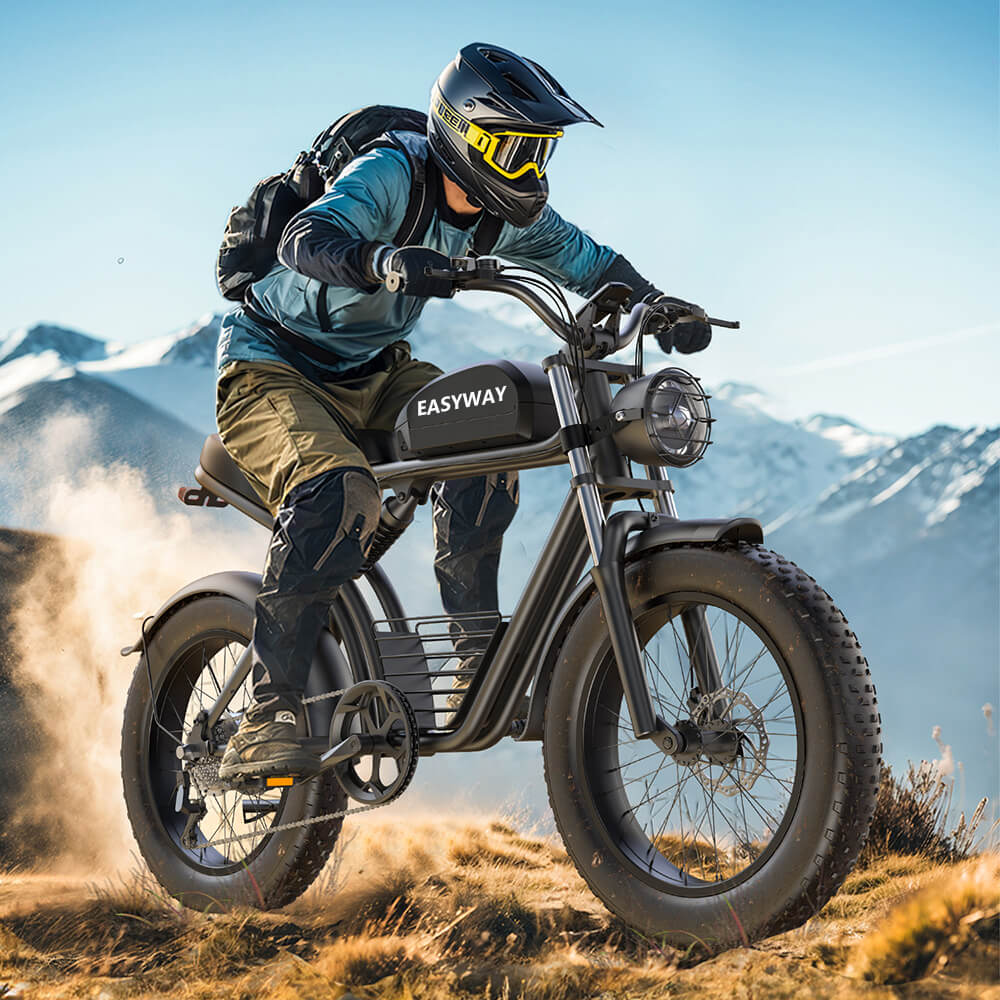
48V 23Ah Electric Bike Battery: How Far Can the F7 Fat Tire E-Bike Really Go?

How Far Can a 48V 23Ah Electric Bike Go?
When choosing a long-range electric bike, battery capacity is one of the most important specifications to understand. A 48V 23Ah battery provides a substantial amount of stored energy, making it suitable for electric bikes designed for longer recreational rides, commuting and mixed-terrain applications.
The Easyway F7 Fat Tire E-Bike uses a 48V 23Ah 18650 lithium battery pack and has a stated riding range of 70–120 km, depending on riding conditions.
The battery’s nominal energy can be estimated using a simple calculation:
48V × 23Ah = 1,104Wh
That means the F7 battery provides approximately 1.1 kWh of nominal stored energy.
However, 1,104Wh does not mean every rider will travel exactly the same distance. Real-world range depends on speed, rider weight, terrain, assist level, tire pressure, temperature, wind, stop-and-go riding and how much motor assistance is used.
Therefore, when evaluating a long-range e-bike, it is better to understand why range varies rather than focusing on one advertised number.
What Does 48V 23Ah Mean?
The two numbers describe different characteristics of the battery.
What Does 48V Mean?
48V represents the nominal voltage of the battery system.
The F7 uses a 48V electrical architecture that connects the battery with its controller and 1500W brushless hub motor.
What Does 23Ah Mean?
23Ah, or amp-hours, represents the battery’s electrical charge capacity.
When voltage and amp-hour capacity are considered together, they provide a better indication of the battery’s total energy.
A simplified calculation is:
Voltage × Amp-hours = Watt-hours
For the F7:
48V × 23Ah = 1,104Wh
This is one reason the F7 can be positioned as a long-range fat tire electric bike rather than a basic short-distance commuter.
However, watt-hours should still be treated as a nominal energy figure, rather than a guaranteed amount of usable energy under every riding condition.
Why Does Battery Capacity Matter for a Long-Range E-Bike?
A larger battery gives an electric bike more stored energy to work with.
This becomes particularly valuable when the bike has a relatively powerful motor.
The F7 combines:
- 48V 1500W brushless hub motor
- 48V 23Ah lithium battery
- 48V 25A intelligent controller
- 20×4.0 fat tires
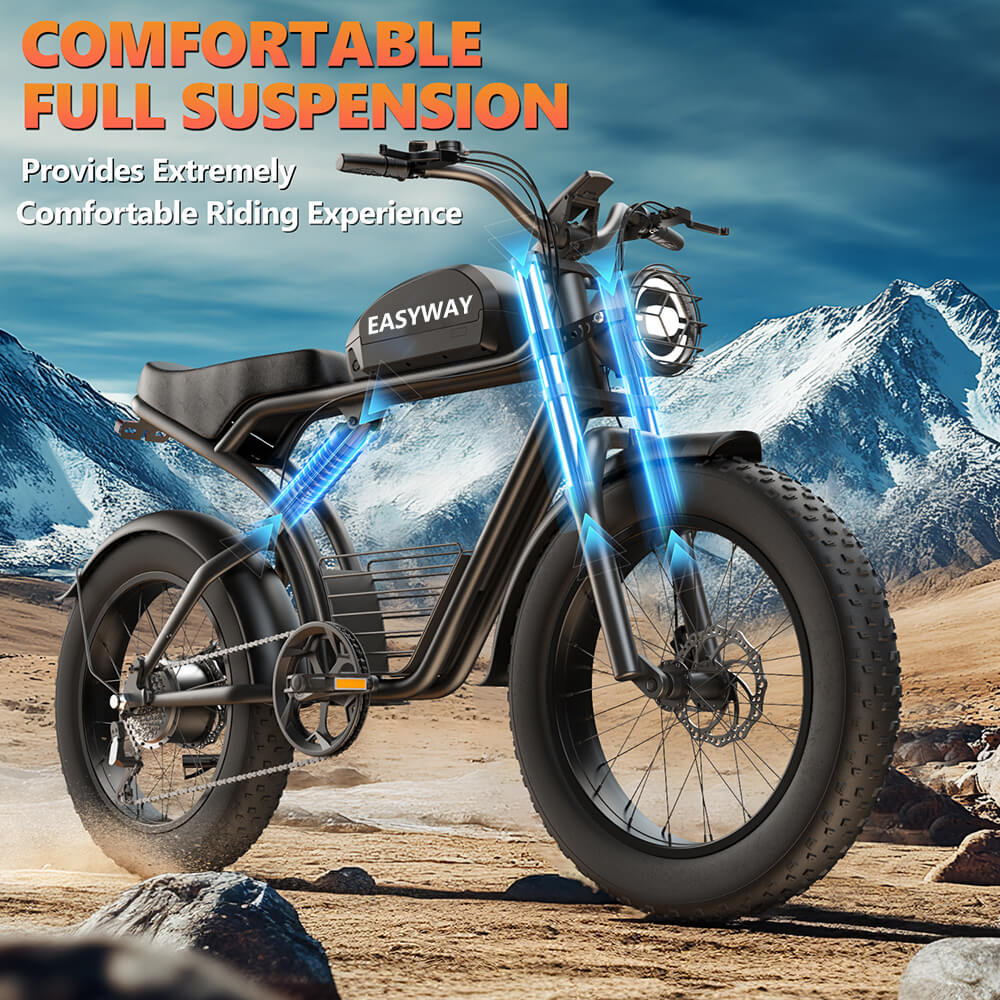
- Full suspension
A high-power motor can consume more energy when operating under heavy load, especially during acceleration and climbing. Therefore, pairing the motor with a substantial battery capacity is important for maintaining useful riding range.
However, this does not mean the motor constantly consumes its maximum rated power.
Power demand changes continuously.
For example:
Flat road + moderate assistance → lower energy consumption
Steep hill + throttle + heavy rider → higher energy consumption
Loose terrain + high speed → higher energy consumption
This is why the same F7 can achieve different distances on different rides.
What Determines the Real-World Range of a 48V 23Ah E-Bike?
Battery capacity is only the starting point.
Several real-world factors determine how much distance a rider can obtain from a single charge.
1. Riding Speed
Speed has a significant effect on energy consumption.
Higher speeds generally require more energy because aerodynamic resistance increases as speed rises.
If a rider wants to maximize range, maintaining a moderate and consistent speed can generally be more efficient than repeatedly accelerating to high speeds.
2. Rider Weight and Load
The heavier the combined rider and cargo weight, the more energy the motor needs to move the bicycle.
The F7 has a stated maximum load of 150 kg, allowing it to accommodate a relatively substantial rider/load combination.
However, maximum load capacity and maximum range are two different concepts.
A heavier load may increase energy consumption even though it remains within the bike’s rated load limit.
3. Terrain
Terrain has a major influence on range.
A flat paved road is typically less demanding than:
- Mountain roads
- Gravel
- Sand
- Mud
- Repeated steep climbs
The F7 is equipped with 20×4.0-inch all-terrain fat tires, making it suitable for a wide range of riding surfaces, but off-road riding can consume more energy than smooth-road riding.
How Does Tire Pressure Affect Electric Bike Range?
Tire pressure is often overlooked when discussing e-bike range.
Fat tires provide a wide contact area, which can improve stability and traction. However, tire pressure influences rolling resistance and handling.
Too little pressure can increase rolling resistance on certain surfaces.
Too much pressure can reduce the tire’s ability to absorb small impacts and may change handling on loose terrain.
For the F7, riders should follow the manufacturer’s recommended tire pressure and adjust appropriately according to riding conditions where permitted.
This illustrates an important point:
Range is not determined by the battery alone.
The interaction between battery, motor, tires, rider and terrain determines the actual result.
How Does the 1500W Motor Affect Battery Consumption?
The F7’s 48V 1500W brushless hub motor provides a high-power configuration, but the motor does not necessarily draw 1500W continuously.
Actual electrical consumption varies according to the load placed on the system.
For example, when traveling on flat ground at a moderate speed, the motor may require considerably less power than when accelerating from a stop or climbing a steep hill.
This is why two riders using the same 48V 23Ah battery can achieve different ranges.
One rider may prioritize:
Speed + throttle + hills
while another may prioritize:
Moderate speed + pedal assist + flat terrain
The second riding style will generally place less demand on the battery.
What Is the Relationship Between Battery, Controller and Motor?
An electric bike’s power system can be understood as a connected chain:
Battery → Controller → Motor → Wheel
The battery provides electrical energy.
The controller regulates current delivery.
The motor converts electrical energy into mechanical movement.
The wheel transfers that movement to the ground.
The F7 uses a 48V 25A intelligent controller, matched to its 48V battery system and 1500W motor configuration.
For manufacturers and buyers, this system-level approach is important because battery capacity alone does not determine how an e-bike behaves.
UL 2849 addresses electrical systems for e-bikes and provides a useful reference for understanding why the battery, drive system and other electrical components should be evaluated as an integrated system.
UL 2849 – Electrical Systems for eBikes | UL Standards & Engagement
How Much Range Can the F7 Provide?
The stated range of the F7 is:
70–120 km
or approximately:
43–75 miles
This should be understood as a range estimate rather than a guaranteed distance.
The actual result will depend on the test conditions.
For example, a ride using moderate pedal assistance on relatively flat terrain may produce a substantially different result from a ride involving:
- High-speed riding
- Frequent throttle use
- Steep hills
- Heavy rider load
- Soft terrain
- Strong headwinds
This distinction is particularly important for B2B buyers.
When presenting range to customers, it is better to communicate it as a range with clearly stated conditions rather than promising one fixed distance.
How Can Riders Maximize the Range of a 48V 23Ah E-Bike?
Riders who want to maximize battery range can focus on several simple practices.
Use Appropriate Pedal Assist
Higher PAS levels provide more motor assistance but can consume more energy.
Using a lower or moderate PAS level when conditions allow can help extend the ride.
Maintain a Consistent Speed
Repeated hard acceleration can consume more energy than maintaining a steady pace.
Check Tire Pressure
Correct tire pressure can help balance traction, comfort and rolling resistance.
Avoid Unnecessary Weight
Carrying unnecessary cargo increases the total load on the bicycle.
Plan for Terrain
If a route includes many steep climbs, riders should expect greater energy consumption than on a flat route.
Maintain the Battery Correctly
Following the manufacturer’s charging and storage recommendations helps support battery performance over time.
What Does Battery Management Mean for an E-Bike?
Lithium-ion batteries require appropriate management because the battery pack contains multiple individual cells working together.
The F7 uses a 48V 23Ah 18650 lithium battery pack.
A battery management system, where equipped, can help monitor and manage factors such as cell voltage and battery operating conditions.
For B2B buyers, battery specifications should therefore be evaluated beyond just the Ah number.
Important questions include:
- What cells are used?
- What battery configuration is available?
- What BMS is used?
- What charger is supplied?
- What certifications or testing apply?
- What market will the battery be sold in?
This is especially important when importing electric bikes into different countries because battery transportation and product compliance requirements may vary.
Why Is the Charger Specification Important?
The F7 uses a:
54.6V / 3A charger
A charger needs to be compatible with the battery’s voltage configuration.
For a nominal 48V lithium-ion battery pack, a 54.6V charging voltage is commonly associated with a fully charged 13-series lithium-ion configuration.
Charging time can vary depending on:
- Remaining battery capacity
- Battery condition
- Charger output
- Temperature
- Charging management system
Therefore, buyers should avoid estimating charging time solely from battery capacity.
The U.S. Department of Energy’s Alternative Fuels Data Center provides background information on lithium-ion battery technology and explains why battery characteristics such as energy density, temperature and charging behavior matter for electric mobility.
U.S. Department of Energy – Alternative Fuels Data Center: Batteries for Electric Vehicles
Why Does Temperature Affect Battery Performance?
Temperature is another factor that can influence battery performance.
Lithium-ion batteries generally perform differently under extreme temperatures compared with moderate operating conditions.
Cold conditions can temporarily affect available battery performance, while excessive heat can create additional challenges for battery management and longevity.
For riders using the F7 in different climates, battery storage and charging should follow the manufacturer’s recommendations.
This is especially relevant for international distributors because an e-bike sold in a cold-weather market may experience different real-world battery behavior from the same model used in a warm climate.
How Should B2B Buyers Compare Long-Range E-Bike Batteries?
For wholesalers and distributors, comparing only the Ah number is not enough.
A better evaluation should include:
Battery Capacity
Look at:
Voltage × Ah = nominal Wh
Cell Type
The F7 uses an 18650 lithium battery pack.
Charger
The F7 uses a 54.6V / 3A charger.
Motor Demand
A higher-power motor can require more energy under demanding conditions.
Intended Application
A commuter, rental bike and off-road adventure e-bike may have completely different energy requirements.
Target Market
Battery, charger and electrical certification requirements should be checked according to the destination country.
Electric Bike OEM & ODM Solutions
Is a 48V 23Ah Battery Enough for Long-Distance Riding?
For many recreational and mixed-use applications, a 48V 23Ah battery provides a substantial energy capacity.
With approximately 1,104Wh of nominal energy, the F7 has a battery configuration designed to support its high-power drivetrain.
Its stated range of 70–120 km gives buyers a useful reference point, but the actual distance should always be evaluated according to riding conditions.
A useful way to think about range is:
Battery capacity determines how much energy is available, while riding conditions determine how quickly that energy is consumed.
This is why a larger battery does not automatically guarantee a fixed distance.
Long Range Is About the Whole System
A long-range e-bike is not simply an e-bike with a large battery.
The complete system matters.
The F7 combines:
48V 23Ah Battery
→ Approximately 1,104Wh nominal energy
48V 1500W Motor
→ High-power propulsion
48V 25A Controller
→ Intelligent power management
20×4.0 Fat Tires
→ Stability and traction
Full Suspension
→ Improved control over uneven terrain
7-Speed Transmission
→ Multiple gearing options
Together, these components create a configuration intended for riders who want both substantial battery capacity and strong motor performance.
Battery Safety and International Market Considerations
Electric bike batteries should be evaluated carefully when products are sold internationally.
For transportation, lithium-ion batteries are subject to specific dangerous-goods requirements because damaged, improperly packed or improperly handled lithium batteries can create fire risks.
The International Air Transport Association (IATA) publishes guidance and regulations concerning the transport of lithium batteries by air.
For B2B buyers shipping electric bikes internationally, understanding applicable battery transportation requirements is an important part of supply-chain planning.
IATA – Lithium Batteries Shipping Regulations
This is particularly relevant when arranging samples, air freight or other international shipments involving lithium battery-equipped electric bikes.
Frequently Asked Questions
How much energy does a 48V 23Ah battery have?
A simple nominal calculation gives:
48V × 23Ah = 1,104Wh
Actual usable energy and riding range depend on operating conditions.
How far can a 48V 23Ah electric bike travel?
The F7 has a stated range of 70–120 km, or approximately 43–75 miles, depending on riding conditions.
Is 48V 23Ah good for a 1500W e-bike?
A 48V 23Ah battery provides substantial energy capacity for a 1500W configuration. Actual performance depends on motor demand, terrain, speed, load and riding mode.
Does riding faster reduce e-bike range?
Generally, higher speeds require more energy, particularly because aerodynamic resistance increases with speed.
Does throttle use affect range?
Frequent throttle use can increase energy consumption compared with efficient pedal-assist riding, particularly during repeated acceleration and climbing.
What charger does the F7 use?
The F7 uses a 54.6V / 3A charger.
What type of battery does the F7 use?
The F7 uses a 48V 23Ah 18650 lithium-ion battery pack.
Conclusion: What Makes the F7 a Long-Range Fat Tire E-Bike?
The F7’s long-range configuration is based on more than a single battery specification.
Its 48V 23Ah battery provides approximately 1,104Wh of nominal energy, while the 1500W motor provides strong propulsion for demanding riding conditions.
Combined with 20×4.0 fat tires, full suspension, a 7-speed transmission and intelligent controller, the F7 is designed as a high-power, long-range fat tire electric bike for recreational, outdoor and mixed-terrain applications.
Its stated range of 70–120 km should be treated as a practical reference rather than a guaranteed distance, because actual range changes with speed, terrain, rider weight, temperature, tire pressure and riding mode.
For distributors and brands, the key takeaway is simple:
A good long-range e-bike is not defined by battery capacity alone. It is the result of matching battery energy, motor demand, controller management, tires, gearing and riding conditions into one complete system.
Request F7 Wholesale & OEM Information